Welcome back to the last part of our series on Building a Financial Crime Mitigation Platform. We have shown how MongoDB ideally supports the technical capabilities of modern digital financial operations as a unified data platform. In case you missed it, be sure to check out the series overview.
In today’s world, fraud management systems need to react in the moment. Immediacy has become a must-have characteristic of control systems. Real-time monitoring is required not only to block potential fraudulent activities, but also to fulfill customers’ expectations. Modern financial services, like instant payments, demand straight-through screening processing that executes all the corresponding checks instantaneously. Therefore, the challenge is to ensure comprehensive checks are executed without creating bottlenecks in the customer experience.
This blog explains how to operationalize enhanced due diligence with an agentic SAR investigation pipeline built with LangGraph and MongoDB. Rather than stopping at alert generation, the solution uses specialized agents to triage suspicious activity, gather evidence in parallel across entities, transaction, network, and watchlist data, analyze investigative leads, draft compliance-ready SAR narratives, and route cases through durable human-in-the-loop review.
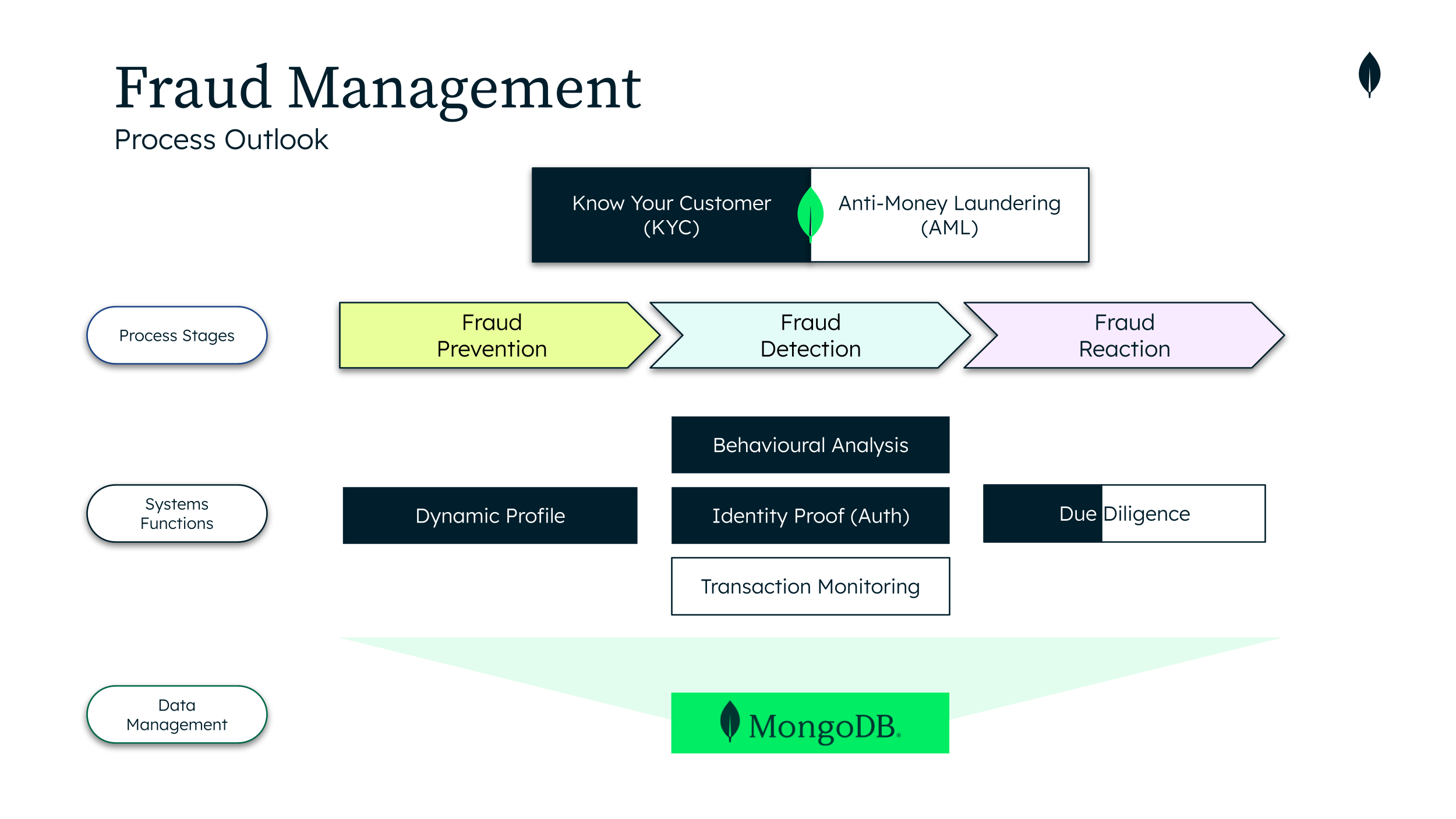
To begin, we must put in perspective the end-to-end process for fraud management, which consists of the following stages:
Figure 1. Fraud management end-to-end process.
Fraud reaction’s due diligence
Previously, we learned how to build a dynamic profile for the fraud prevention stage. Then, we analyzed how fraud detection can be enhanced by conducting a behavioural analysis and transaction monitoring. Now, if an activity has been flagged as suspicious, then we have arrived at the last stage, fraud reaction: here we need to combine information from the customer profile, the anti-money laundering policies, with the transaction’s contextual information, along with the Suspicious Activity Report generated in the previous step. This last process is known as due diligence.
Enhanced due diligence
Historically, digitized anti-money laundering (AML) solutions focused on dashboarding and rule-based automation. While these improved service level agreements (SLAs), they introduced a "fragmentation tax" risk. Analysts must manually stitch together disparate data points, leading to high false-positive rates and significant operational latency.
Agentic AI introduces a paradigm shift: rather than relying on brittle, hard-coded rules, financial services institutions can deploy autonomous, specialized agents that synthesize disparate data points in real-time. However, for these agents to be effective in an enterprise setting, they require more than just a large language model (LLM); they require a durable, high-performance data backbone.
Digitized solutions came to the rescue to support risk analysts in their jobs. Mainly, by enabling reporting dashboards, powered by fast search engines, and automating some tasks with rule-based logic. Even though digitized solutions drastically improved SLAs, it was still error-prone. Several studies have shown that not only the rate of false positives remains high, but they are increasingly running on a costly operation with little to no return on investment (ROI).
(Agentic AI) Enhanced due diligence
Agentic AI capabilities make the perfect fit for this scenario: Having smart agents that can automate manual checks more accurately, being able to easily combine several data points, or better yet generate synthetic data for evaluating potential scenarios, and lastly bringing natural language interactive ability, makes the perfect co-pilot to risk analyst for providing precise recommendations in complex cases, or to have the full autonomy to approve or reject evident cases that won’t require a human escalation.
Putting into practice agentic AI-enhanced due diligence (EDD)
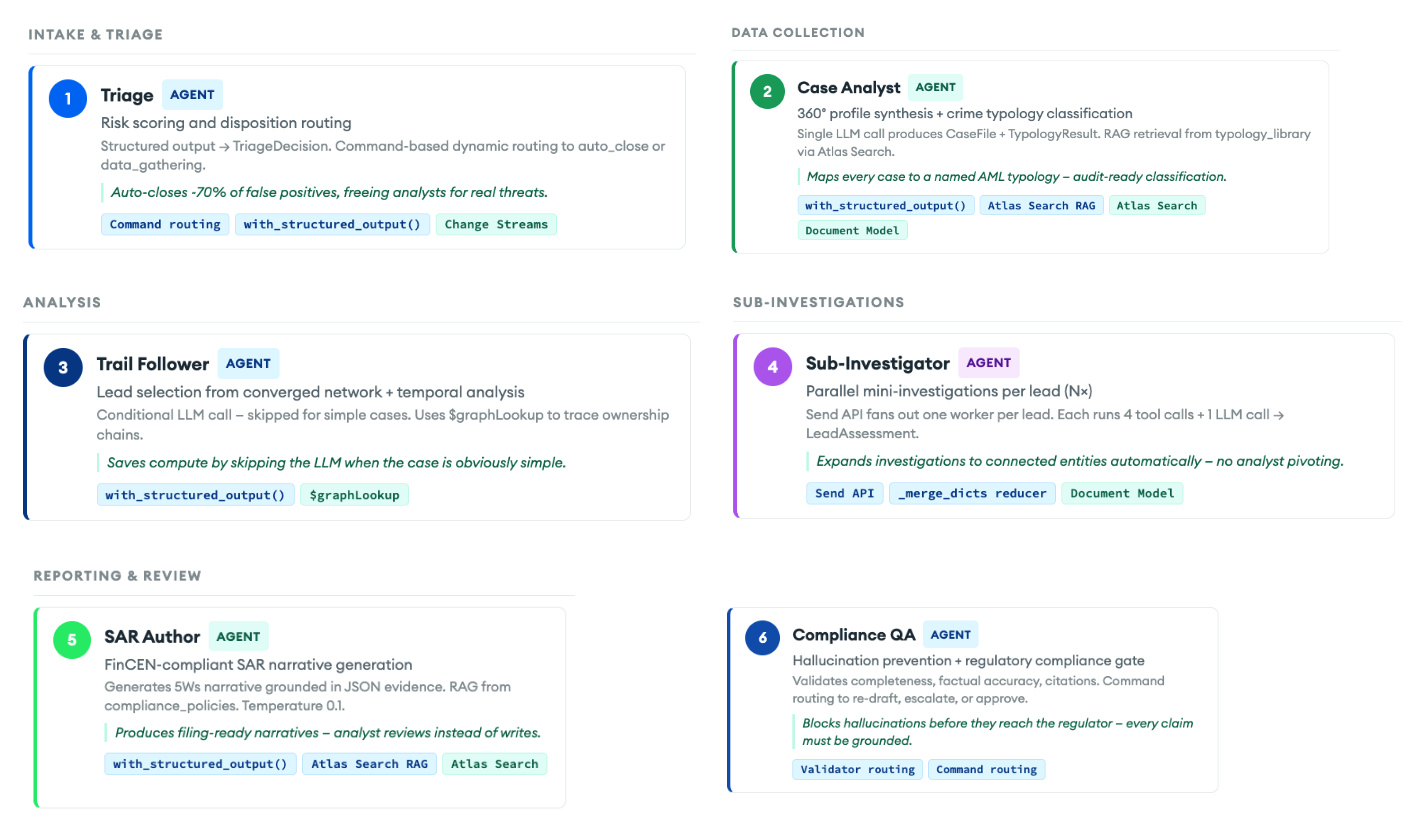
Coming back to the demo prototype we’ve explored in the series, we have a team of agents specialized in completing specific tasks:
Figure 2. Specialized agents created for enhanced due diligence operations.
When operationalizing Agentic AI for “fraud reaction”, the architectural focus must be on state management. A common pitfall is assuming the agent itself holds the "truth." In enterprise AML, the agent is merely the processor; the state must reside in a durable, persistent store.
MongoDB and LangGraph provide an ideal architectural fit: LangGraph provides the orchestration and dynamic routing, and MongoDB serves as the single source of truth. Its flexible document model handles the polymorphic nature of AML data (SARs, alerts, and entity metadata) without the need for destructive schema migrations. Leveraging MongoDB Atlas Vector Search allows financial institutions to consolidate transactional data and vector embeddings into a single store, eliminating the "database sprawl" associated with maintaining separate vector databases and operational stores.
For CTOs, "agentic" does not imply "unsupervised." The true power of this architecture lies in the Human-in-the-loop (HITL) pattern as an explicit Audit Design Pattern. Using MongoDB to store the complete provenance of an agent’s decision-making process supports auditability by making every step traceable. Risk analysts do not just see a final decision; they see the chain of thought and the data sources that led to that decision, allowing for faster, more confident sign-offs.
Figure 3. Stages for automating having a Human-in-the-loop as “analyst review” step.

Agentic process workflow
After building and configuring the specialized agents comes the agentic process workflow:
Figure 4. Agentic workflow for enhanced due diligence operations.
.png)
- The process begins with a notification to the triage agent that a new Suspicious Activity Report (SAR) has been registered. It proceeds to launch a few sub-agents for fetching actions: gathering information from the entity, transactions, watchlists, and network.
- Next, it derives all the consolidated information to a case analyst agent, which in turn orchestrates the analysis done by sub-agents. It sends all the generated output to a SAR author agent, an expert in Due Diligence terminology, which ensures that the case is documented using the organization's terminology.
- The SAR is handed over to a compliance QA agent that ensures that it is following the policies, rules, and standards defined by the risk management organization. Using its natural language capabilities, it can adjust accordingly.
- Lastly, the case is handed over to the risk analyst for the final human review in order to be dispatched for the corresponding compliance enforcement action.
Takeaways
Implementing agentic AI shifts your fraud mitigation strategy from "manual effort" to "autonomous scale." To successfully scale this architecture, keep these foundational principles in mind:
- Design for specialization: Do not build "general purpose" agents. Design specialized agents with narrow scopes to simplify monitoring, governance, and model optimization.
- Centralize state, distribute logic: Maintain a single contextual data layer (MongoDB) as your source of truth. Allow your orchestration framework (LangGraph) to handle the logic, but offload the persistence of state to the data platform.
- Prioritize auditability: Ensure your agentic workflow captures not just the output, but the context and references used for each decision. This transforms "AI recommendations" into "compliance-ready logs."
This is the last article in this series. We would like to thank you for joining us in this journey. Feel free to revisit the series to have a full picture of building a Financial Crime Mitigation platform powered by a modern data platform like MongoDB. We also invite you to check out our prototype (demo repo) and share any feedback or suggestions. Thank you!
Next Steps
Read the Financial Crime Mitigation series:
Overview: Financial Crime Mitigation with MongoDB / Series Overview
Part I: Financial Crime Mitigation with MongoDB / Part I: Dynamic Customer Profile
Part II: Financial Crime Mitigation with MongoDB / Part II: Comprehensive Analysis
For a technical deep-dive, check out the guided step-by-step tutorials on building a Financial Crime Mitigation Platform with MongoDB Atlas and AML Network Analysis with $graphLookup.