Use cases: Payments
Industries: Financial Services, Security and Compliance
Products: MongoDB Atlas, Queryable Encryption, Encryption at Rest using Customer Key Management, Private Endpoints, Database Auditing, PCI DSS Certification
Partners: Amazon Web Services
Solution Overview
PCI DSS constitutes the reference standard for protecting payment account data. It sets a baseline of technical and operational practices for systems that store, process, or transmit CHD. It gives teams a common reference point for how payment systems should be secured and controlled.
Protecting payment data usually involves encryption. With a conventional approach, once a field is encrypted, it can no longer be searched by its value. For a payment platform this limitation represents a practical problem, because fraud investigation depends on searching sensitive fields, such as a customer's email, phone, or account reference. Without a way to search encrypted data, investigation forces an uncomfortable choice: either decrypt data in bulk, which widens exposure, or work slower and offline. This dilemma leads to the solution’s design question:
How can a payment platform keep data encrypted at rest, and still let fraud analysts search it by value?
PCI DSS raises the bar for how payment data is protected. Its latest versions, v4.0 and v4.0.1, put more weight on continuous compliance, point-in-time audits, and treat scope reduction to lower assessment effort for service providers.
Under PCI DSS, compliance follows a shared-responsibility model: MongoDB Atlas ensures the operational security of the host platform, while customers control their deployment's configuration and data policies.
Stated plainly, using MongoDB does not, on its own, make a solution PCI DSS compliant. Compliance is assessed against a specific environment, covering the product, its processes, and the organization. MongoDB Atlas offers a certified infrastructure plus data-layer features that reduce the amount of work to achieve compliance and shrink the audit scope. The value here is acceleration and scope reduction, not a compliance guarantee.
What PCI DSS Looks Like, and Where the Layers Split
The PCI Security Standards Council maintains PCI DSS and organizes a set of requirements grouped under control objectives:
Objective | Requirements |
|---|---|
Build and maintain a secure network |
|
Protect account data |
|
Maintain a vulnerability management program |
|
Implement strong access control |
|
Regularly monitor and test networks |
|
Maintain an information security policy |
|
Under the shared-responsibility model, these requirements split across these layers:
Infrastructure layer (the provider's responsibility): Comprises physical security, network controls, platform patching, and encryption at rest of the underlying storage. MongoDB Cloud is a PCI DSS certified service provider, validated by a QSA, Coalfire Systems. For the CHD environment in MongoDB Cloud, a QSA can rely on the MongoDB Cloud AOC, available on request through the MongoDB Trust Center. This pre-validated layer eliminates the need for customers to re-audit the underlying infrastructure.
Application layer (the customer's responsibility): Comprises how the product stores, protects, queries, masks, and audits CHD, and who is allowed to read the information. This layer remains the customer's design decision.
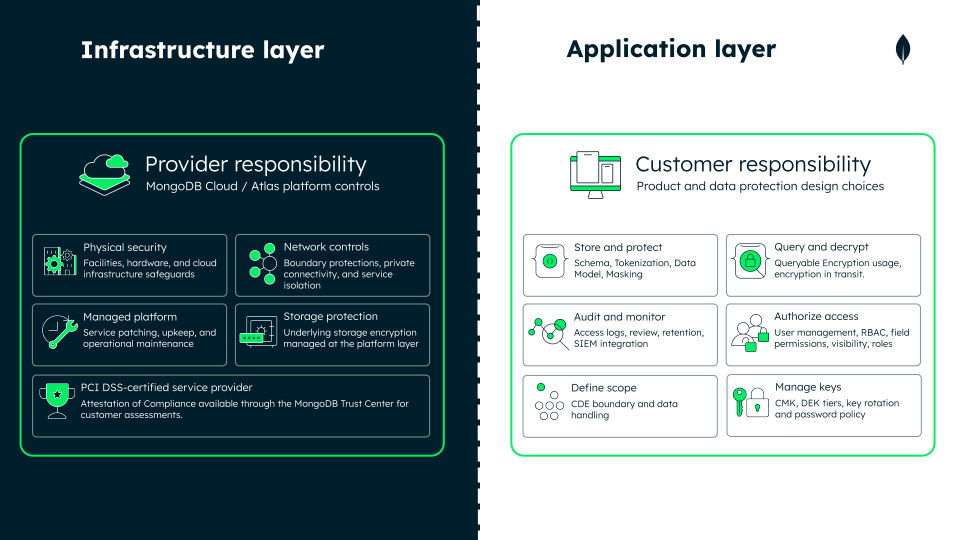
Figure 1. PCI DSS shared responsibility layered model
The PSP project fills the application layer. It comprises a reference architecture and a set of best practices. It shows how to use MongoDB to align the application layer with the PCI DSS control objectives for protecting stored data, restricting access, monitoring it, and reducing audit scope. This project constitutes a starting point to accelerate the PCI DSS adoption.
The Architectural Proposal
The PSP project is a PCI DSS-aligned PSP platform. It runs the payment lifecycle on MongoDB Atlas: card checkout and authorization, automated fraud scoring, and multi-tier analyst investigation. It shows how analysts can search encrypted data with a clear design philosophy:
Encrypt everything. Query anything. Keys are yours.
With the infrastructure layer inherited from Atlas (see Figure 1), the remaining work happens at the application layer. Atlas provides diverse features to support this work, with Queryable Encryption being the central one. The full set of features is enumerated in the MongoDB capabilities section.
Queryable Encryption in Focus
With a conventional approach, a field is either kept in plaintext so it can be searched (readable by anyone with database access), or encrypted so it is protected (but no longer searchable). Queryable Encryption removes that either/or for the query types it supports.
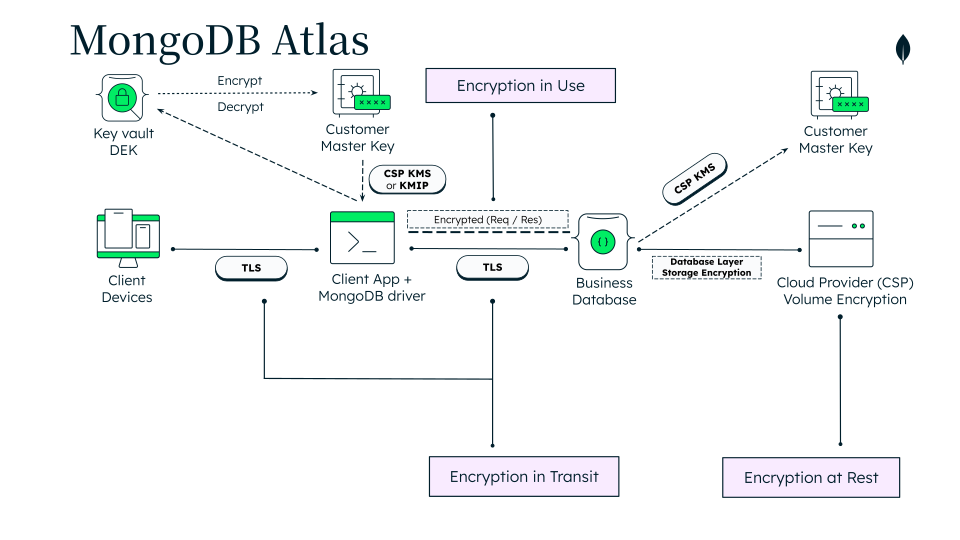
Figure 2. MongoDB Encryption Architecture: Queryable Encryption, Key Management, and Data Protection Layers
For an equality-searchable field, the flow proceeds as follows:
The driver encrypts the search value on the client side, using the field's DEK.
The server matches that encrypted value against an encrypted index. It compares ciphertext to ciphertext and does not decrypt the field.
When matching documents return to the application process, the driver decrypts the target fields in memory. MongoDB Atlas stores and processes only ciphertext, held as BSON Binary Subtype 06; as a result, a database administrator with full cluster access sees only opaque bytes.
The concrete effect in the PSP project: a fraud analyst searches for a customer by encrypted email, phone, or account reference and gets the record back, while the plaintext value does not reach Atlas. This capability keeps sensitive PII encrypted at rest and available by value, without the bulk decryption that widens the CDE.
Fields that need protection but not search use a non-searchable mode, decrypted only for an authorized, escalated request. The data model section covers both modes and the fields they protect.
MongoDB Capabilities for the Application Layer
The PSP project combines several MongoDB and Atlas capabilities. Each maps to a specific part of the PCI DSS application-layer work:
Capability | Role in the Project | PCI DSS Control Objectives | MongoDB Documentation |
|---|---|---|---|
Queryable Encryption:equality | Search encrypted PII (email, phone, account reference) by exact match; the field is encrypted client-side, so the database server stores and processes only ciphertext for it and does not receive the plaintext. | Protect stored account data; restrict access. | |
Queryable Encryption:non-searchable, and Client-Side Field Level Encryption | Encrypt high-sensitivity fields (address, government ID, raw gateway payload) for retrieval only, decrypted client-side. | Protect stored account data; restrict access. | |
Customer-Managed Keys | Keep the Customer Master Key in the customer's own Key Management Service; the master keys stay there and MongoDB does not have access to them, while the data keys are encrypted under them. | Protect stored account data. | |
Automatic Encryption Shared Library: | Perform encryption and decryption in the driver/application process, so plaintext for encrypted fields does not cross the wire to Atlas. | Protect stored account data; encrypt in transit. | |
RBAC and Identity Federation | Granular role-based access at database and collection level, with LDAC / Active Directory, OpenID Connect, and workforce identity federation for authentication. | Restrict access by need to know; identify and authenticate users. | |
Two-Tier Data Encryption Key Hierarchy | Enforce least-privilege field visibility cryptographically, backed by per-tier Atlas roles and database users. | Restrict access by need to know. | |
Private Networking | Keep cardholder-data traffic on the cloud-provider backbone over private endpoints, with IP allowlisting, forming a defined network boundary around the CDE. | Build and maintain a secure network. | |
Atlas Database Auditing | Record access to sensitive fields as an audit record and forward audit logs to a SIEM system for review. | Log and monitor all access. | |
Transport Layer Security 1.3 on Atlas Connections | Encrypt cardholder data on every network hop. | Encrypt data in transit. | |
Document Model with BIAN-Aligned Schema | Model card, transaction, and party data so cardholder data can be isolated and minimized. | Supports scoping and data minimization. |
Adjacent Use Cases
The core principles of this solution, including a stable API boundary, field-level Queryable Encryption, and a DEK-per-access-tier model, can be applied to other use cases:
Open finance: Consent-scoped data access that restricts a third party to the fields a customer authorized, such as PSD2 and consumer data right.
Healthcare: Protected health information under the HIPAA.
Insurance and wealth: Platforms handling government identifiers and financial account data under the GDPR.
Reference Architectures
The PSP project is the payment gateway position in the standard card payment chain:
Merchant backend
Payment gateway: Processor, acquirer, card network, and issuer
It owns the PCI DSS-scoped storage, the encryption, and the access control that governs who can read which cardholder-data fields. It does not emulate the card network or the processor; so the architecture focuses on the data-security layer.
Downstream actors such as the processor, acquirer, card network, and card issuer are external subsystems, reached through providers. In the demo, each provider has a built-in module that keeps the project self-contained, but they can be replaced by a real external subsystem in production. The card issuer is one such provider: its built-in module stores card data internally for the demo, whereas in production that data would live in an external issuer.
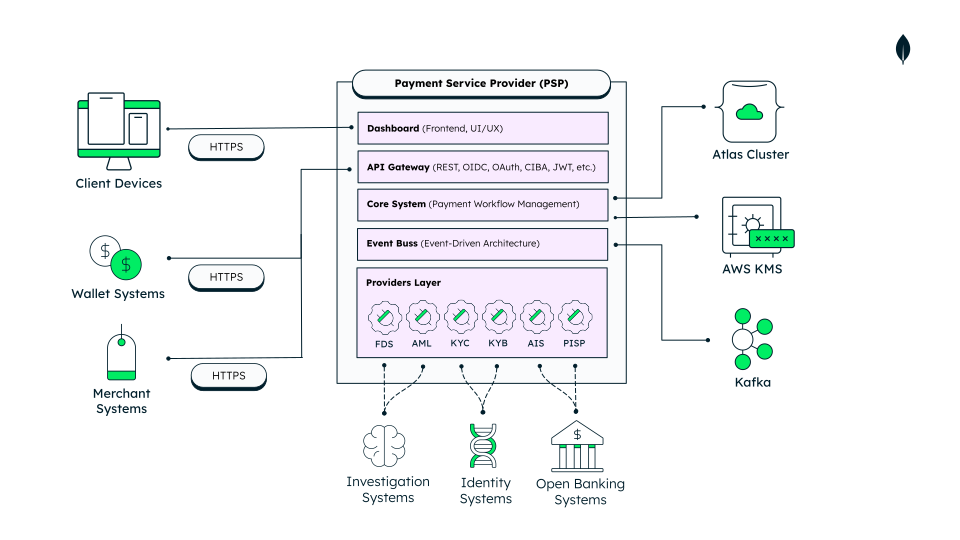
Figure 3. PSP platform layered architecture and external components
Architecture Components
The architecture uses the following components:
PSP dashboard (Frontend): The presentation layer. It does not talk to the database directly. On checkout it tokenizes the PAN so the full PAN is not transmitted or stored by the PSP core.
PSP API gateway (Backend): The single entry point and the only component that can decrypt protected fields. It holds the Queryable Encryption client, resolves the caller's role, and selects the correct key tier per request. All callers, including the user interface, service accounts, and integrations, pass through the same API and are subject to the same RBAC and key rules.
MongoDB Atlas (M10 or higher) with Queryable Encryption: Stores only ciphertext (Binary Subtype 06) for every protected field. A database administrator with full cluster access sees opaque bytes. TLS 1.3 protects all data in transit. The PSP project relies on equality search, which is supported in production.
AWS KMS: Holds the CMK that wraps and unwraps the data encryption keys. The CMK stays in KMS, and MongoDB does not have access to it. A local key provider is available as an offline fallback for demos.
Note
Queryable Encryption support for prefix, suffix, and substring queries is in public preview and requires MongoDB 8.2 or later. Ensure you’re using MongoDB 8.2 or later on both the Atlas cluster and the crypt_shared library. Equality and range queries do not need 8.2.
Data Model Approach
The PSP project data model follows BIAN service domain naming conventions, so every collection and field maps to a service domain defined in the BIAN standard. On top of BIAN, MongoDB Queryable Encryption defines the field-level security posture.
Query Types and How the Project Applies Them
MongoDB Queryable Encryption keeps a field encrypted client-side while still allowing the server to query the ciphertext. The PSP project uses these query types:
Equality (production): The searchable mode for the PCI DSS-scoped lookup keys. The driver encrypts the query value and matches it against an encrypted index, so the server does not decrypt the field. This feature lets a fraud analyst find a record by email, phone, or account reference without exposing plaintext.
No query (retrieval-only): The non-searchable mode for the highest-sensitivity fields, including residential address, government identifier, and raw gateway payloads. An authorized client decrypts these fields just-in-time only.
Range (production): Used for value-band lookups, such as filtering by an amount range. It keeps the amount encrypted.
Prefix, suffix, and substring (public preview): Demonstrated for KYC style partial-match lookups on encrypted identity fields.
For the PCI DSS-scoped card and PII fields below, the access design reduces to the following categories:
Field | Classification | Encryption Mode | Searchable |
|---|---|---|---|
| Account reference / PII |
| Yes |
| Account reference |
| Yes |
| PII |
| Yes |
| PII |
| Yes |
| CHD |
| No |
| High PII |
| No |
| High PII |
| No |
| Sensitive operational |
| No |
| Network token | Plaintext | Yes |
| Display only | Plaintext | No |
Full PAN ( | CHD | Not stored by the PSP core | n/a for the PSP core |
CVV and PIN | Sensitive Authentication Data | Never stored | n/a |
Design choices that keep cardholder data out of scope where possible include:
PAN tokenization: The application replaces the full PAN with a
tok_<uuid>surrogate token and retains only the last four digits for display purposes.Zero SAD capture: Endpoints never capture SAD such as CVV or PIN.
Reduce Scope through Segmentation and Tokenization
A common PCI DSS practice keeps cardholder data out of systems that do not need it, so that most of the platform falls outside the CDE. These techniques apply segmentation, which isolates the CDE from the rest of the system, and tokenization, which replaces the primary account number with a surrogate token held in a dedicated tokenization vault. Segmentation is not a PCI DSS requirement, but it takes systems out of scope and reduces assessment cost; when used, it must be documented, justified, and validated.
The PSP project applies these techniques at the data layer:
The full PAN never resides in the PSP core: The core stores only the surrogate token, the BIN, and the last four digits. Most of the platform carries no cardholder data and stays out of scope. The full PAN belongs to the card-issuer subsystem, which is external in production. In the demo, a replaceable built-in issuer module stands in and stores the PAN in its own isolated vault, encrypted with
QE:equality. This field can be matched for exact lookup and duplicate detection without being decrypted.PII is centralized: Identity fields, such as email, or phone, live in a single BIAN SD-13 party collection that the agreement, card, and transaction records reference. One place to protect and process a data-subject erasure request.
Sensitive fields sit behind a separate key tier:
QE:nonefields use a different data encryption key tier than the searchableQE:equalityfields, so the boundary between sensitive and non-sensitive data is enforced by the keys.
This is a reference pattern, not a certification. The CDE definition and its validation remain the customer's responsibility and the assessor's to confirm.
Access Control Enforced Keys, Not Application Code
Separate DEK back the encryption tiers:
Lookup tier:
QE:equalitykeys are available to all authenticated analyst roles for search.Sensitive tier:
QE:nonekeys are available only to a level 2 investigator holding a valid, short-lived escalation token, and to a read-only security auditor.The design core: A level 1 client's encrypted-field map omits the sensitive keys, so the driver cannot decrypt those fields and returns them as ciphertext. Field-level access control here is cryptographic rather than a projection in application code, which reduces the risk of an accidental leak through a query bug. When an analyst escalates a case and a level 2 investigator approves, the investigator receives an escalation token that activates the sensitive-tier client pool for that request.
Build the Solution
This section is a deployment guide for teams that want to run and evaluate the solution. It covers the configuration choices that matter for a successful deployment, how to run the stack locally and how to deploy it for production. Use this GitHub repository to implement this solution.
Set up the prerequisites
Verify that your project complies with the following requirements:
Node.js 20 LTS or higher.
Docker and Docker Compose (recommended to run the full stack).
A MongoDB Atlas cluster, M10 or higher. Queryable Encryption is not available on free clusters.
A key provider, such as AWS KMS, or the local provider,
PSP_KMS_PROVIDER=local, for offline development.The Automatic Encryption Shared Library. Download it from the MongoDB Enterprise downloads and point to
MONGODB_CRYPT_SHARED_LIB_PATH. The backend falls back to common install paths if unset.
Configure the key management service
Use the database setup command npm run setup:db to provision the MongoDB key vault. Use a DEK for each encrypted field, wrapped by the CMK. This step is idempotent, so you can safely re-run it to reuse existing keys.
Use a managed KMS, such as AWS KMS, for any production or production-like deployment. The CMK stays in the organization’s own account and MongoDB does not have access to it.
For AWS KMS, configure the provider through environment variables:
PSP_KMS_PROVIDER=aws AWS_CMK_ARN=arn:aws:kms:<region>:<account-id>:key/<key-id> AWS_REGION=<region> AWS_ACCESS_KEY_ID=<access-key-id> AWS_SECRET_ACCESS_KEY=<secret-access-key> AWS_SESSION_TOKEN=<token> # optional, for temporary credentials
Alternatively, use a local key provider which keeps the master key in an environmental variable. This setup operates as a workaround for offline demos and local development, and is not appropriate for real cardholder data.
Configure the local KMS workaround for offline demos only:
PSP_KMS_PROVIDER=local PSP_KMS_LOCAL_MASTER_KEY=<96-byte base64 key> # generate with: npm run setup:key:master
The local provider requires a 96-byte base64 master key. MongoDB Queryable Encryption expects this size for a local provider.
Configure the event bus
The platform is event-driven. Business and compliance events flow over an event bus. The engine is selected by EVENT_BUS_ENGINE, and the same publisher and consumer code runs regardless of the choice.
Use Kafka for production or high-throughput environments, so events are durable, partitioned, and consumable by other systems.
EVENT_BUS_ENGINE=kafka KAFKA_BROKERS=broker1:9092,broker2:9092 KAFKA_CLIENT_ID=pci-psp KAFKA_SSL=true KAFKA_SASL_MECHANISM=plain # or scram-sha-256 / scram-sha-512 KAFKA_SASL_USERNAME=<username> KAFKA_SASL_PASSWORD=<password> EVENT_BUS_TOPIC_PREFIX=pci.psp
Use the in-process engine for less demanding environments like local development, demos, or low-volume deployments.
EVENT_BUS_ENGINE=in-process
Card data travels as an encrypted envelope, so the choice of engine does not change the PCI DSS posture.
Set additional configurations
Set the following values in the root .env before starting the stack:
MongoDB Atlas:
MONGODB_URI,MONGODB_DB_NAMEQE shared library:
MONGODB_CRYPT_SHARED_LIB_PATHAuthentication:
PSP_JWT_SECRET,PSP_OAUTH_KEY_PROVIDERFrontend/merchant:
NEXT_PUBLIC_PSP_URL_BACKEND_PUBLIC,PSP_MERCHANT_OAUTH_CLIENT_ID,PSP_MERCHANT_OAUTH_CLIENT_SECRET,PSP_MERCHANT_SESSION_SECRET
The repository contains a .env file to edit; see the Installation wiki page for the full list.
Run the demo locally with Docker Compose
Install dependencies, provision and seed the database, then start the stack. Docker Compose is the recommended path for a first run. It starts the backend, the PSP portal, and the merchant app as a self-contained containerised stack:
npm run setup # install root + backend + frontend + merchant dependencies npm run setup:db # create QE collections, provision DEKs and indexes npm run setup:seed # insert synthetic BIAN demo data docker compose up # start the full stack
For local development with hot reload, use npm run dev instead of docker compose up.
Once running, the services are available at:
PSP portal at http://localhost:8080
Merchant app at http://localhost:8082
Backend API at http://localhost:8081
OpenAPI/Swagger at
/docHealth check at
/api/v1/system/health
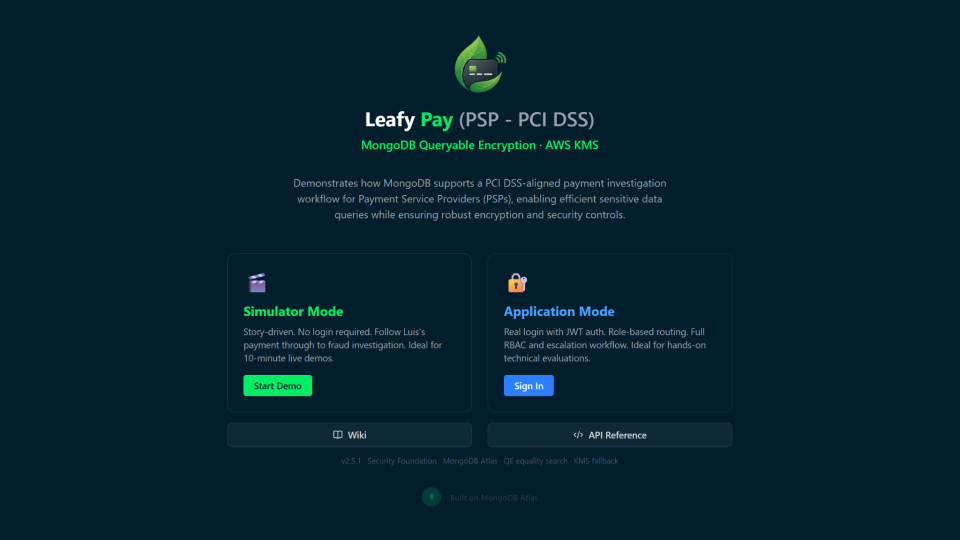
Figure 4. Leafy Pay application demo user interface
setup:db requires a live M10 or higher Atlas cluster with valid KMS credentials. The demo uses only synthetic data.
Deploy for production
For a production or shared environment, deploy to Kubernetes rather than a single Docker Compose host:
npm run deploy:kube # Kubernetes deploy via tools/kube.ts npm run deploy:docker # alternative: containerised deploy with docker compose
Recommended production settings:
Use AWS KMS for the key provider and the Kafka event bus.
Provide the QE per-tier connection strings and credentials as Kubernetes secrets.
Terminate client traffic over TLS, and reach Atlas over private endpoints where available.
Scale the backend horizontally once AWS KMS is in place; keep a single replica only while running on the local key provider.
Key Learnings
Design for shared responsibility from day one: MongoDB Atlas's PCI DSS certification lets the infrastructure layer be inherited through the AOC, but the application layer remains the customer's responsibility.
Enable encryption and searchability together: Queryable Encryption supports exact-match search on encrypted PII without the server decrypting it, which can ease the "decrypt to investigate" trade-off that tends to widen PCI DSS scope.
Enforce access control with keys, not just code: A per-tier DEK model makes field-level access cryptographic. A low-privilege client cannot decrypt sensitive fields, which lowers the chance that a query bug leaks them.
Reduce scope before protecting data: Tokenizing the PAN and storing only the masked last four digits keeps most of the system out of cardholder-data scope. Data that is out of scope needs fewer controls than data that is encrypted but still in scope, so scope reduction shrinks the audit surface.
Design the audit trail to outlive the keys: Keep the append-only access log unencrypted and separate from the data it describes, so it stays readable through key rotation and supports the access logging and monitoring that PCI DSS expects.
Authors
- Antonio Membrides Espinosa, MongoDB